Robots that sew.
A general-purpose sewing robot, trained on data from real production.
The cheapest garment labor on Earth. No hiring. No training. No downtime.
40 million people. $140 billion a year.
That is what it takes to make the world’s clothes.1 Fabric is soft and unpredictable, so sewing is the hardest step to automate. It still employs about two-thirds of garment workers.2
A strong place to start: US defense uniforms. By law, they’re almost all made in the US,3 where labor is costly and skilled sewers are aging.4 The Pentagon spends over $1 billion a year5 on them: the need, the funding, and the scale, in one customer.
One robot. Any stitch. Any garment.
Built with robot learning, and trained on data from real factory work.
Cheaper than Asia, wherever our robots work.
By Year 5, from Mexico and Asia. By Year 10, from the US too.
It already sews.
Cheap and simple grippers are slower than human hands, but at scale, our financial model shows they still beat Asian labor.7
94% sellable, at 64% of a skilled sewer’s speed on a simple seam. A person loads each piece.
Sleeves sewn to production grade by our robot under teleoperation. It’s the task we’re automating next.
Hanging shirts at 98% success over 4 hours. A person resets the shirt and hanger each time. Clip shows one cycle.
Our handheld device costs a fraction of a robot. In our tests on four tasks, it replaced 90% of robot data without hurting performance. Pictured: an early prototype at our partner factory in Vietnam.
One AI controls both the robot and the sewing machine 50 times a second, and keeps a memory as it moves through a task. Here it’s tested on a conveyor belt, which poses many of the same challenges as sewing.
Automate the sewer, not the factory.
Sewing work is hard to hire for, train, keep, and scale. There are two ways to automate it:
Each new process is built around specific garments, fabrics, or steps.
Robots built to sew any garment, at the machines factories already own.
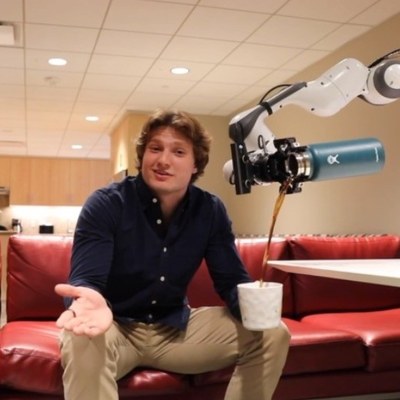
Close to a decade of robot learning research at UC Berkeley, Stanford, and CollectedAI. Led DROID, a robot manipulation dataset with 20× more scenes than any robot-collected dataset before it.8 To build it, he raised $2M and ran a data collection network of 100 people across 15 institutions, including a distributed 50-person operations team and 20 frontier robotics researchers.

30+ years building anything and everything, including 10 automated factories across Asia and the US, garment automation at Shima Seiki and CreateMe, and robots at Boston Dynamics, Google, and J&J. Has won and delivered grants and contracts for the Departments of Defense (including DARPA), Energy, and the Treasury.
Proving it works in a real factory setting.
A station that runs itself.
Our robot attaches sleeves at a factory station, on its own, picking cut pieces from a pile. We’ll measure speed, quality, and success rate against a person, and report them as they are.
Starting with US uniforms.
The US military buys clothing at scale and, by law, buys it made in the US. We want to work with the US manufacturers that make it.
After that, our goal is a robot that sews a whole shirt on its own.